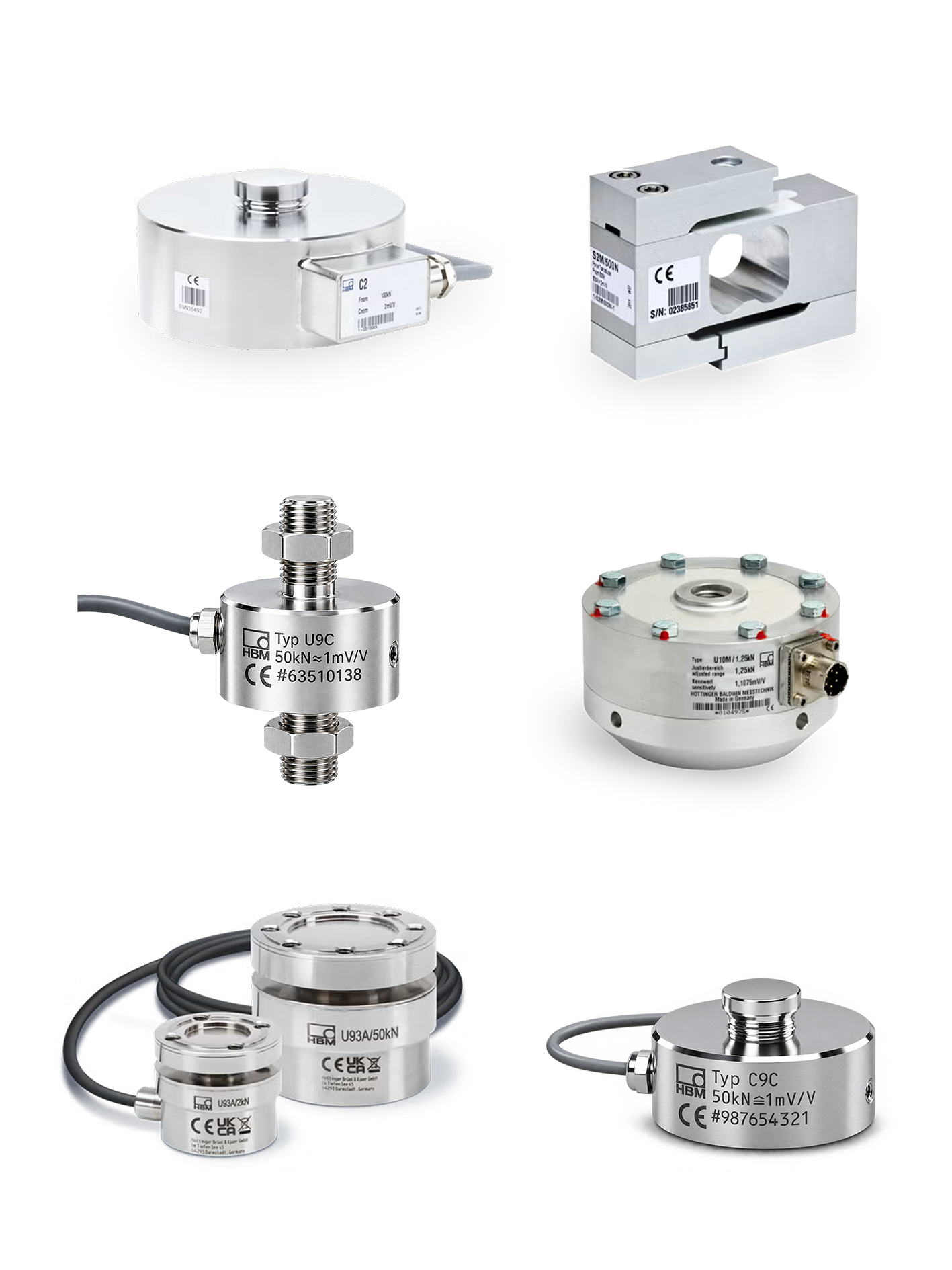
Analog and USB Output signal conditioner
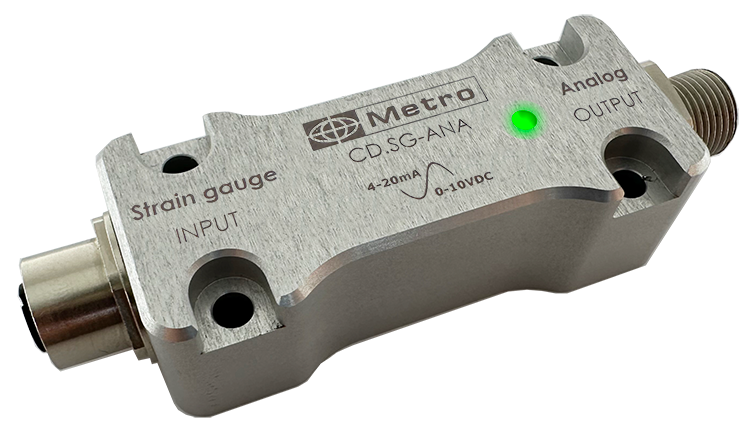
CD1-SG-ANA signal conditioner
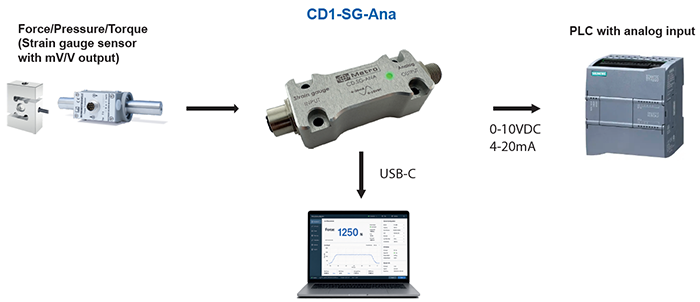
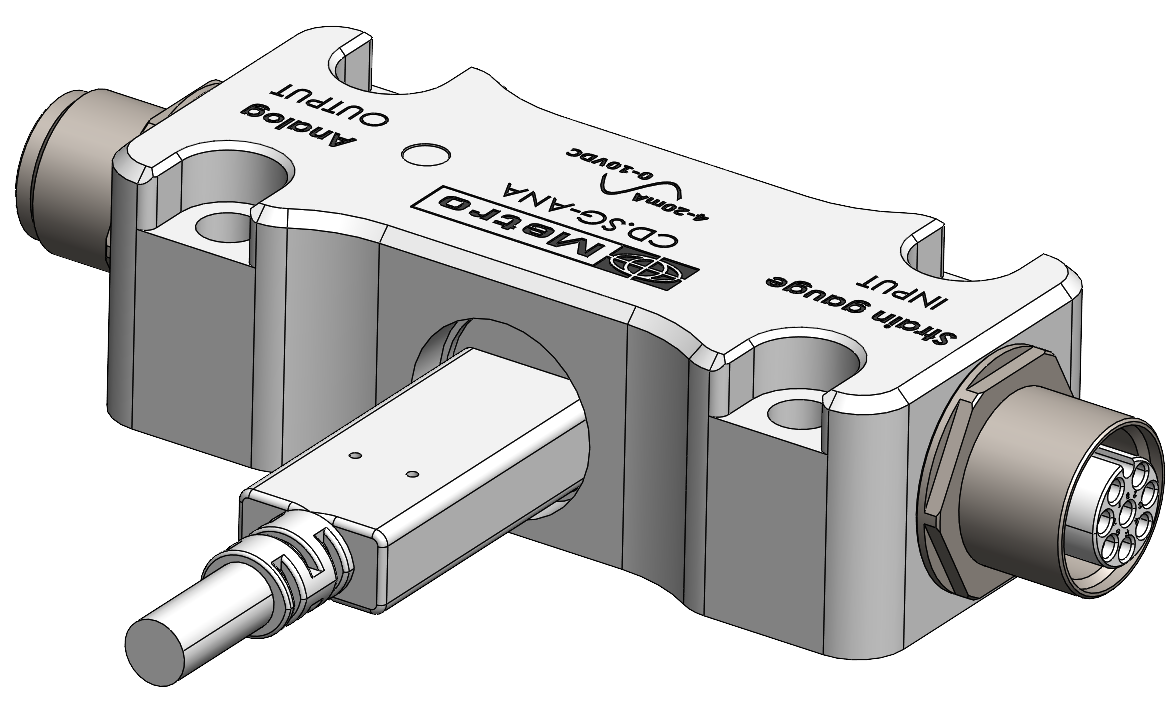
The CD1-SG-ANA signal conditioner provides digital acquisition and processing of signals from strain gauge sensors. A modern, PC-configurable solution with an analog output for strain gauge sensors.
The signal is converted by a 24-bit ADC, then digitally processed before being output via USB, 0–10 V or 4–20 mA.
The device comes factory-calibrated across 5 measurement ranges, with a calibration certificate available via the USB port. The analog outputs are generated by a 16-bit DAC and can be adjusted via a 2-point calibration using the included software.
This design replaces the manual adjustments via potentiometers found in conventional signal conditioners. It prevents adjustment errors and ensures greater accuracy. The user receives a product that is already calibrated, traceable, and ready to use, while still retaining the ability to precisely adjust the analog outputs to suit their application.
• Direct readings and dynamic measurements (peak, etc.) (via USB output using the software)
• 1 input for 4- or 6-wire full-bridge strain gauge sensors.
• TEDS 0-wire compatible (plug-and-play sensors)
• Accuracy: 0.01% of full scale (amplifier only) (80 ... 5000 Ω) via USB output
• Accuracy: 0.05% of full scale (amplifier only) (80 ... 5000 Ω) via analog output
• 4800 Hz sampling rate with multiple filtering options
• Calibration certificate included
• Suitable for the harshest industrial environments thanks to its machined aluminum
housing and electronic design.
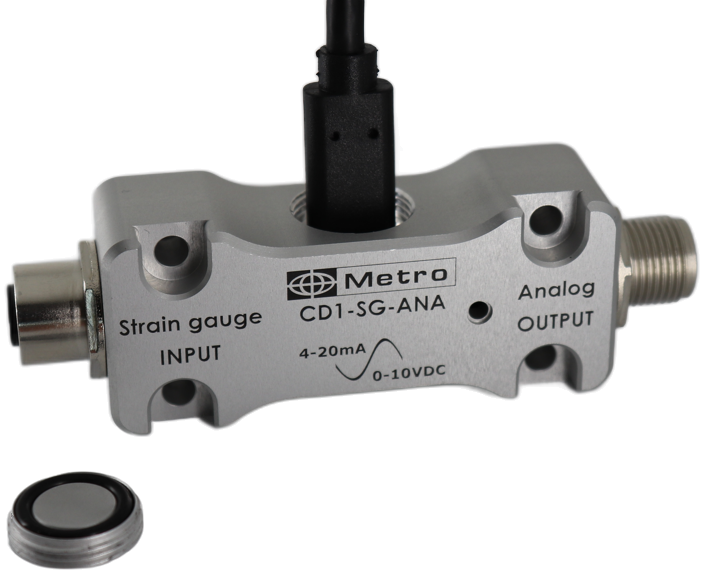
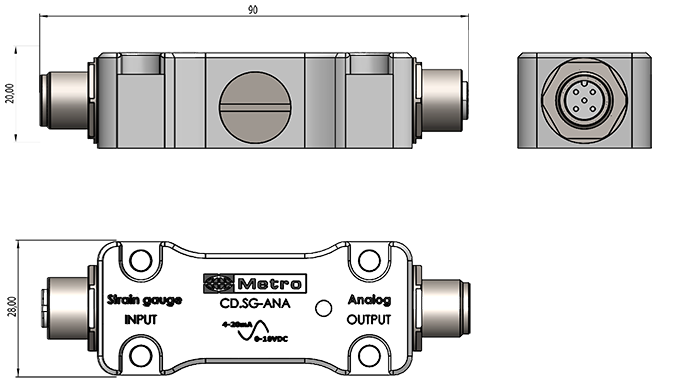
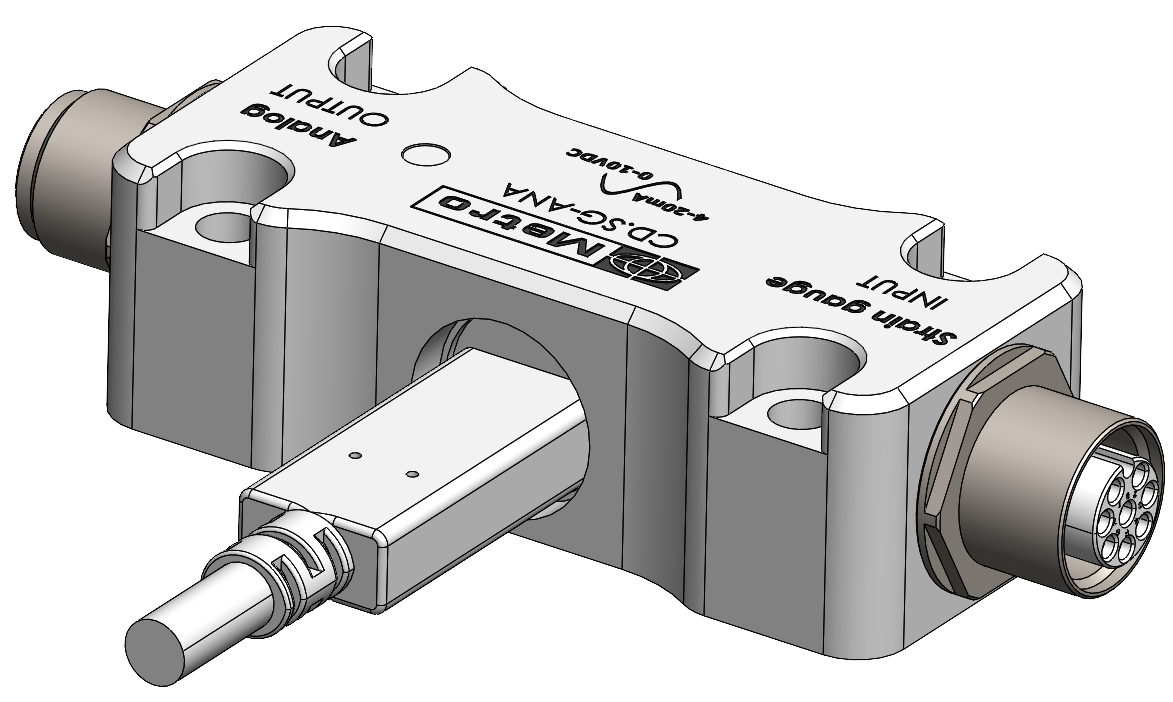
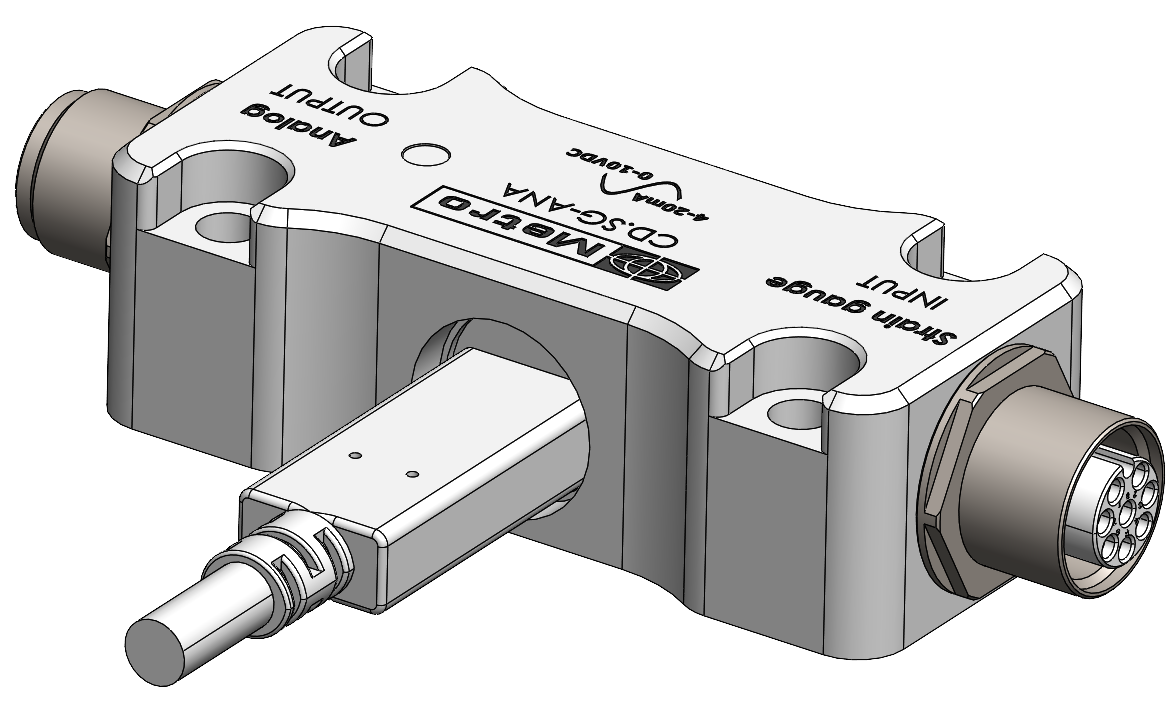
The CD1-SG-ANA is housed in a machined aluminum enclosure, offering exceptional durability and an IP67 rating, ensuring complete resistance to harsh industrial environments.
Installation is simple and flexible: it can be mounted from the top using 4 M4 screws, or from the bottom using 4 M5 screws, depending on the mounting requirements.
|
Characteristic |
Unit |
CD1-SG-IO-Link |
|
Mode |
|
Direct value, minimum and maximum peaks (via USB output, using software) |
|
Measurement input |
|
1 strain gauge input, full bridge |
|
Transducer technology |
|
4-wire and 6-wire full-bridge strain gauge |
|
Relative linearity error |
% |
USB Digital Output: Accuracy: 0.01% ≤ 30 m, 0.05% ≤ 100 m Analog Output: Accuracy: 0.05% ≤ 30 m |
|
Transducer impedance |
Ω |
80…5000 Ω |
|
Measurement Ranges |
mV/V |
2.5, 10, 20, 100 |
|
Converter frequency |
Hz |
4,800 |
|
Calibration mode |
|
Selected via USB interface: - Enter manufacturer data - TEDS - User calibration (2 points) |
|
Bridge excitation voltage |
V |
5 |
|
Sensor connector |
|
8-pin M12 female connector, code A |
|
Maximum sensor cable length |
m |
100 |
|
A/D conversion |
bits |
24 |
|
D/A conversion |
bits |
16 |
|
Digital filters |
|
Bessel, Butterworth, exponential moving average |
|
Transducer identification |
|
TEDS, IEEE 1451-4 Zero-wire |
|
Noise (peak-to-peak) at 25 °C |
|
|
|
With 10 Hz Bessel filter |
uV/V |
0.2 |
|
With 100 Hz Bessel filter |
uV/V |
0.6 |
|
Without filter |
uV/V |
1 |
|
Nonlinearity |
% |
0.005 of full scale |
|
Zero drift |
%/10K |
0.01 of full scale |
|
Zero drift at full scale |
%/10K |
0.01 of the measured value |
|
Power supply |
V |
24 |
|
Nominal temperature range |
°C |
-20 / +80 |
|
Equipment protection rating |
|
IP67 |
|
EMC requirements |
|
Compliance with Group 1, Class B according to EN 55022 (emission) Compliance with Criterion B for ESD and surge according to EN 61326-1 (immunity) IEC 802-2 (Level II), IEC 801-3 (Level III), IEC 801-4 (Level III) |
|
Weight |
g |
80 |
|
Dimensions |
mm |
20×28×90 |
|
Housing |
|
Machined aluminum |
Bringing a load reading back to an existing PLC.
Adding a force measurement to a machine already in service means adapting to the PLC in place, without rewriting its program. The CD1-SG-ANA provides a 0-10 V or 4-20 mA output that any standard analogue input can read. The strain gauge bridge signal is converted by a 24-bit ADC and processed digitally, giving a conventional PLC input a resolution that analogue conditioners cannot deliver.
Commissioning without a screwdriver.
On a conventional conditioner, zero and gain are set with potentiometers: a delicate adjustment that depends on the operator and can drift with vibration or temperature. The CD1-SG-ANA is supplied with factory calibration across five measuring ranges and a calibration certificate on the USB output. Replacing a transducer or a conditioner now requires only a two-point software adjustment, and the machine restarts with a repeatable setting.
Load monitoring on test benches and special-purpose machines.
A special-purpose machine builder adding a force measurement needs a compact component, installed as close as possible to the transducer, and a measuring chain whose traceability can be justified to their own customer. The CD1-SG-ANA is fitted inside the machine, can be adjusted precisely to the application's working range and arrives as a calibrated, traceable product, which shortens both bench commissioning and final acceptance.